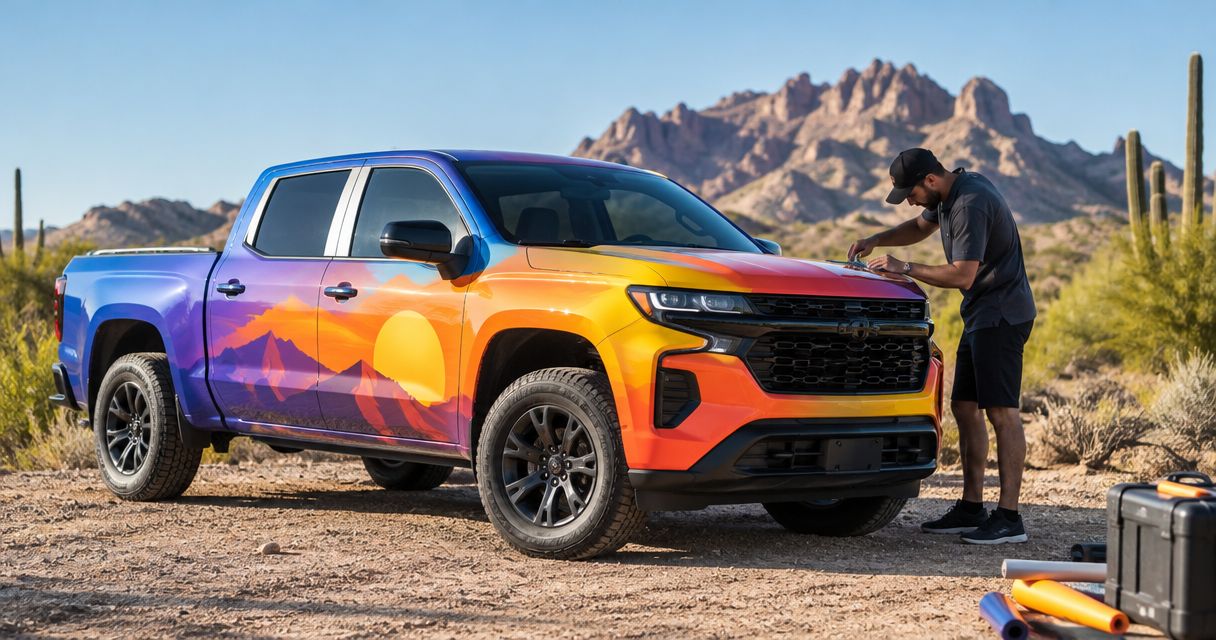
Best overall: printable cast vinyl. Best for solid-color changes: color-change cast vinyl. Best budget option for temporary, flat-panel graphics: polymeric calendered vinyl. This 2026 guide compares vehicle wrap vinyl types for Arizona heat so you can specify the right material before ordering a business vehicle wrap from State48print.
- Printable cast leads vehicle wrap vinyl types for Arizona heat when full-wrap graphics must follow vehicle contours.
- Choose color-change cast for solid finishes, not printed advertising campaigns.
- Limit polymeric calendered vinyl to suitable flat-panel graphics; avoid treating it as a full-wrap substitute.
- State48print provides vehicle wraps for businesses; specify film, laminate, exposure, and installation requirements before approving production.
Why this matters
Arizona heat makes material selection a system decision, not a choice between glossy and matte. Sun exposure, panel orientation, vehicle shape, surface condition, and installation all affect how a wrap performs.
For a 2026 full-wrap specification, start with conformability and the film manufacturer's intended application. A film suited to a flat door graphic is not automatically suitable for a recessed van panel. Likewise, a published durability statement is not a promise that every panel on your vehicle will look the same for that entire period.
State48print vehicle wraps serve business branding needs. Choose the material around the vehicle and the campaign—not around a sample swatch alone.
What makes the best vinyl for Arizona heat?
Use these criteria before comparing finishes or approving artwork:
- Conformability: The film must suit the actual curves, recesses, rivets, and panel transitions it will cover.
- Exposure suitability: Check the manufacturer's guidance for the local climate and for horizontal versus vertical surfaces.
- Matched construction: For printed graphics, specify a compatible film, ink system, and protective overlaminate.
- Adhesive suitability: Match the adhesive to the substrate, paint condition, installation method, and intended removal.
- Finish and care: Choose gloss, satin, matte, or reflective construction with its cleaning requirements in mind.
- Application scope: Separate full wraps from spot graphics. Those jobs do not place the same demands on vinyl.
For an initial vehicle survey, photograph 3 panel zones: the roof, the sides, and the hood. These are useful inspection zones, not a substitute for checking every wrapped surface. They make it harder to approve a material using only the easiest, flattest part of the vehicle.
Vehicle wrap vinyl types at a glance
These 2026 rankings separate different jobs rather than pretending every material competes for the same use case. Film categories guide the shortlist; the exact technical data sheet decides whether a particular product belongs on your vehicle.
| Vinyl type | Best for | Standout feature | Key limitation |
|---|---|---|---|
| Printable cast vinyl | Printed full wraps and complex business graphics | Conforms to complex vehicle contours when properly specified and installed | Requires a compatible printing and protection system |
| Color-change cast vinyl | Solid-color vehicle transformations | Provides a finished color without printing the color itself | Does not replace printed vinyl for custom advertising artwork |
| Conformable reflective vinyl | Visibility-focused fleet markings | Returns incident light toward its source | Application limits vary; reflective film is not automatically suitable for deep recesses |
| Polymeric calendered vinyl | Temporary graphics on suitable flat panels | Fits simpler, limited-scope graphics applications | Less suitable than cast film for complex curves and demanding full wraps |
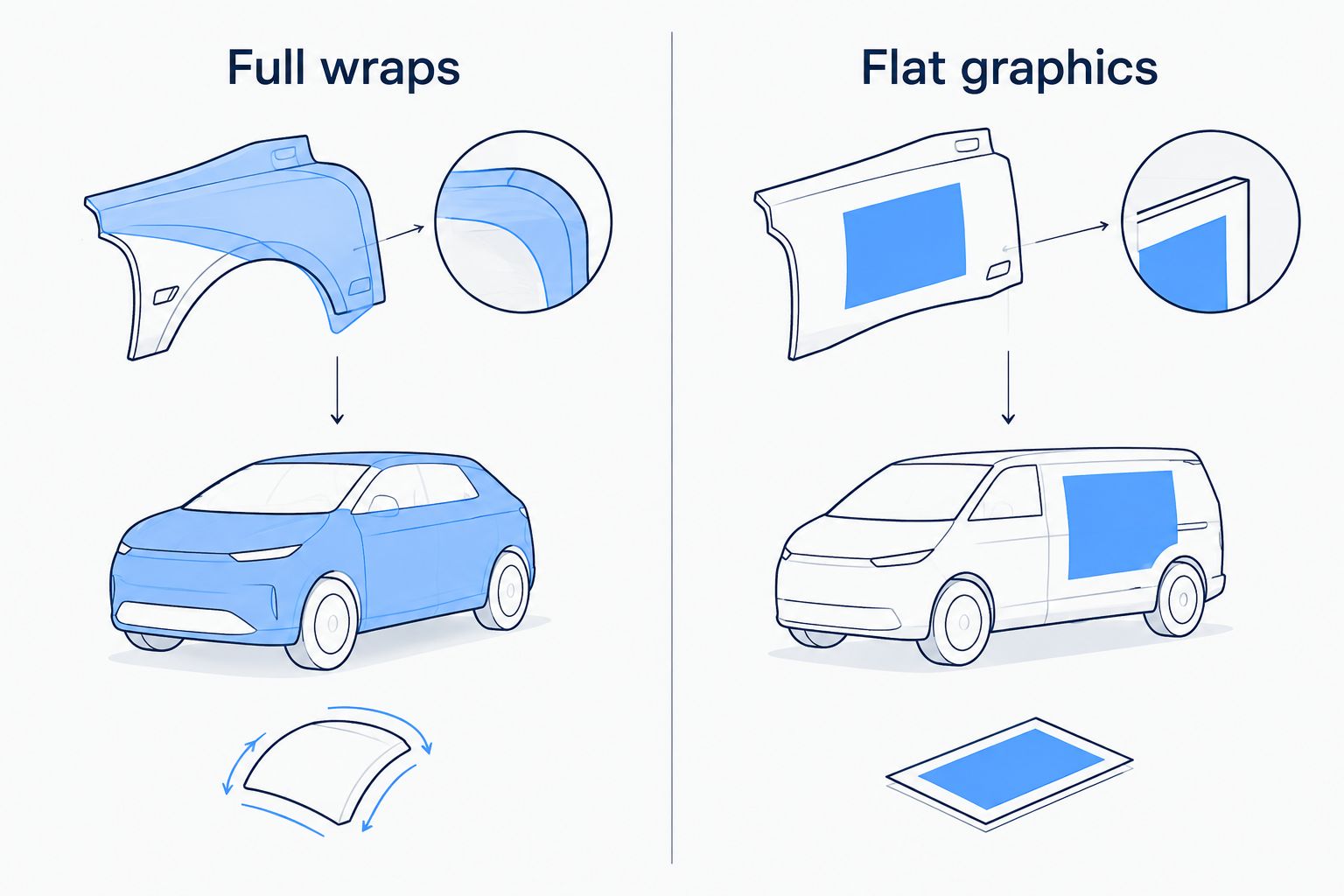
The distinction is between full wraps and flat graphics. Printable cast belongs on the full-wrap shortlist; polymeric calendered belongs on the flat-graphics shortlist, subject to the specific film's application guidance.
1. Printable cast vinyl: best for printed full vehicle wraps
Printable cast vinyl is the strongest default for a business vehicle carrying photographs, gradients, logos, and other custom artwork across complex bodywork. Cast film is manufactured by casting a liquid formulation rather than rolling the material into a sheet, and suitable wrap grades offer the conformability needed for demanding vehicle shapes.
The word cast is a starting point, not the complete specification. You still need the exact film, compatible overlaminate, adhesive characteristics, and installation instructions.
Printable cast vinyl pros:
- Suitable wrap grades follow curves and recesses that challenge less conformable films.
- Supports custom printed branding rather than limiting the design to a manufactured solid color.
- Allows a matched protective overlaminate to be specified for the printed graphic.
- Fits full-wrap layouts that carry artwork across multiple vehicle panels.
Printable cast vinyl cons:
- A cast base film does not correct an incompatible laminate or incorrect installation.
- Printing, finishing, and surface preparation introduce additional production requirements.
- Exposure and care still affect appearance; cast construction does not make a wrap immune to sunlight.
For a printed wrap, request the names of 2 matched components: the printable film and its overlaminate. Confirm that the manufacturer approves the combination. Do not assume that any clear laminate preserves the conformability or application suitability of the base film.
Best for: Branded vans, trucks, and other business vehicles needing full printed coverage over complex shapes.
Verdict: Buy printable cast vinyl for full-wrap advertising, with the complete material system specified.
2. Color-change cast vinyl: best for solid-color transformations
Color-change cast vinyl supplies the finish as part of the film rather than relying on a printed image to create it. Choose this category when the main objective is a consistent body color or finish, with branding handled separately if needed.
For your 2026 specification, separate appearance from suitability. A matte sample tells you how the finish looks; it does not establish the film's suitability for a hood, a roof, or a deep recess.
Color-change cast vinyl pros:
- Provides a manufactured color or finish without printing the underlying color.
- Suitable wrap grades conform to vehicle contours.
- Supports a clear design direction when the vehicle's overall appearance matters more than detailed advertising artwork.
Color-change cast vinyl cons:
- Does not reproduce a custom photographic campaign or multicolor advertising layout by itself.
- Finish-specific cleaning requirements affect how you maintain the vehicle.
- Repairs require attention to material identity and appearance, particularly after the existing wrap has weathered.
Choose the finish with the vehicle's actual cleaning routine in mind. Do not approve a specialty surface and then maintain it using products or methods the film manufacturer excludes.
A protective coating is also a separate decision. Confirm compatibility instead of assuming a coating intended for painted vehicles is suitable for every vinyl finish.
Best for: Businesses seeking a solid-color vehicle transformation rather than a printed campaign.
Verdict: Buy color-change cast vinyl for a finish-led project; skip it as a substitute for custom printed artwork.
3. Conformable reflective vinyl: best for visibility-focused markings
Retroreflective vinyl returns incident light toward its source. That makes it useful for selected fleet markings and graphics intended to respond to vehicle headlights.
Reflectivity and conformability are different properties. Choose a reflective film explicitly approved for the intended vehicle surface; do not assume a material suitable for flat markings can also wrap a bumper or recessed panel.
Conformable reflective vinyl pros:
- Adds a light-returning function that ordinary printed or color-change vinyl does not provide.
- Supports targeted markings instead of requiring a full reflective vehicle treatment.
- Allows visibility requirements to shape the graphic layout from the start.
Conformable reflective vinyl cons:
- Stretching, seams, and panel geometry require material-specific planning.
- The daytime appearance does not fully represent how the graphic looks under directed light.
- Reflective graphics alone do not establish compliance with any vehicle-marking requirement.
Evaluate the proposed layout in daylight and under directed light. If your vehicle is subject to a marking regulation, check the applicable rule separately and specify the required material and placement.
For Arizona use, apply the same exposure checks you would use for other films. Reflective construction is not evidence of greater heat resistance or longer outdoor service.
Best for: Fleet identification and selected markings where returning headlight illumination is an explicit requirement.
Verdict: Buy conformable reflective vinyl for a defined visibility function; skip it as a generic heat-resistance upgrade.
4. Polymeric calendered vinyl: best for temporary flat graphics
Polymeric calendered vinyl is manufactured by rolling vinyl into a sheet. Suitable products fit simpler graphics on flat or gently curved surfaces, making this category a practical shortlist for limited-scope vehicle messaging.
Keep the application narrow. A temporary graphic on a suitable flat panel is a different job from stretching a full wrap through channels and around compound curves.
Polymeric calendered vinyl pros:
- Fits suitable flat-panel lettering, logos, and campaign graphics.
- Supports a limited application when full vehicle coverage is unnecessary.
- Keeps the material decision focused on the actual graphic rather than a full-wrap specification.
Polymeric calendered vinyl cons:
- Generally offers less conformability and dimensional stability than cast wrap film.
- Is not the default choice for deep recesses or complex full-wrap applications.
- A short campaign does not remove the need to check adhesion, exposure, and removal guidance.
For a 2026 promotional campaign, describe the intended removal point before choosing the film. Then check that the specific adhesive and application guidance fit the vehicle's paint and the campaign conditions.
Do not treat temporary as permission to ignore removal. The condition of the underlying paint and the removal procedure still matter.
Best for: Temporary business graphics on suitable flat vehicle panels.
Verdict: Buy polymeric calendered vinyl for an approved flat-panel application; skip it for a complex full wrap.
How these vinyl types are ranked
Printable cast ranks first because this guide prioritizes printed business wraps over complex vehicle surfaces. Color-change cast, reflective film, and polymeric calendered vinyl each win a different assignment: solid finishes, light-returning markings, and temporary flat graphics.
This is an application-based ranking, not a laboratory comparison of named products. No category label establishes a universal Arizona service life. The exact film documentation, exposure conditions, and installation requirements determine the final specification.
Which vehicle wrap vinyl should you choose?
Choose printable cast vinyl for a full printed business wrap. Move to color-change cast when the project is primarily about a solid finish, reflective film when light return is required, or polymeric calendered when suitable temporary flat graphics are enough.
State48print is best for businesses seeking vehicle-wrap services as part of their branded print work. Bring the vehicle requirements into that conversation before treating a visual mockup as production approval.
For your 2026 project, put 1 written specification alongside the artwork approval. Include:
- Vehicle surfaces: Identify the panels being covered and any paint or repair concerns.
- Material identity: Name the film and any compatible overlaminate.
- Exposure guidance: Confirm suitability for the intended surfaces and local conditions.
- Installation requirements: Record the preparation and finishing instructions that apply.
- Care and removal: Keep the manufacturer's maintenance guidance with the vehicle records.
Ask for a precise answer when a proposal says only premium vinyl. That phrase does not identify the construction, adhesive, application limits, or protection system.
Plan Your Vehicle Wrap
Match your business graphics to the vehicle surfaces, exposure, and intended use.
FAQ
What's the best vehicle wrap vinyl for Arizona heat?
Printable cast vinyl is the best default for a full printed business wrap over complex vehicle contours. Confirm the specific film's exposure guidance, compatible overlaminate, and installation requirements before approving it.
Is cast vinyl better than calendered vinyl for a full wrap?
Cast wrap vinyl is generally better suited to complex full wraps because of its conformability and dimensional stability. Suitable polymeric calendered films remain an option for simpler flat-panel graphics.
Does matte vinyl handle Arizona heat better than gloss?
A matte finish alone does not establish better heat performance than gloss. Compare the exact film specifications and exposure guidance rather than ranking materials by appearance.
Should a printed vehicle wrap have an overlaminate?
Specify the protective overlaminate required or recommended for the selected printed wrap system. The laminate must be compatible with the base film and intended application; a generic clear film is not an equivalent specification.
Can I use reflective vinyl across an entire vehicle?
Use reflective vinyl across a vehicle only when the selected film is approved for the surfaces and application involved. Reflective performance does not automatically establish suitability for stretching, deep recesses, or complex curves.
How long will a vehicle wrap last in Arizona?
There is no single service-life figure that applies to every Arizona vehicle wrap. Film identity, panel orientation, exposure, installation, and maintenance all affect the result, so use the specific manufacturer's guidance.
What should I ask State48print before approving a vehicle wrap?
Ask State48print to identify the proposed film, any overlaminate, and the surfaces included in the wrap. Confirm the relevant installation, exposure, care, and removal guidance alongside the artwork.
One last thing
Approve the difficult panel, not just the easy door. Ask how the selected material will handle the roof, hood, recesses, and panel transitions included in your design. A wrap specification that addresses those surfaces gives you a better basis for approval than a finish sample alone.