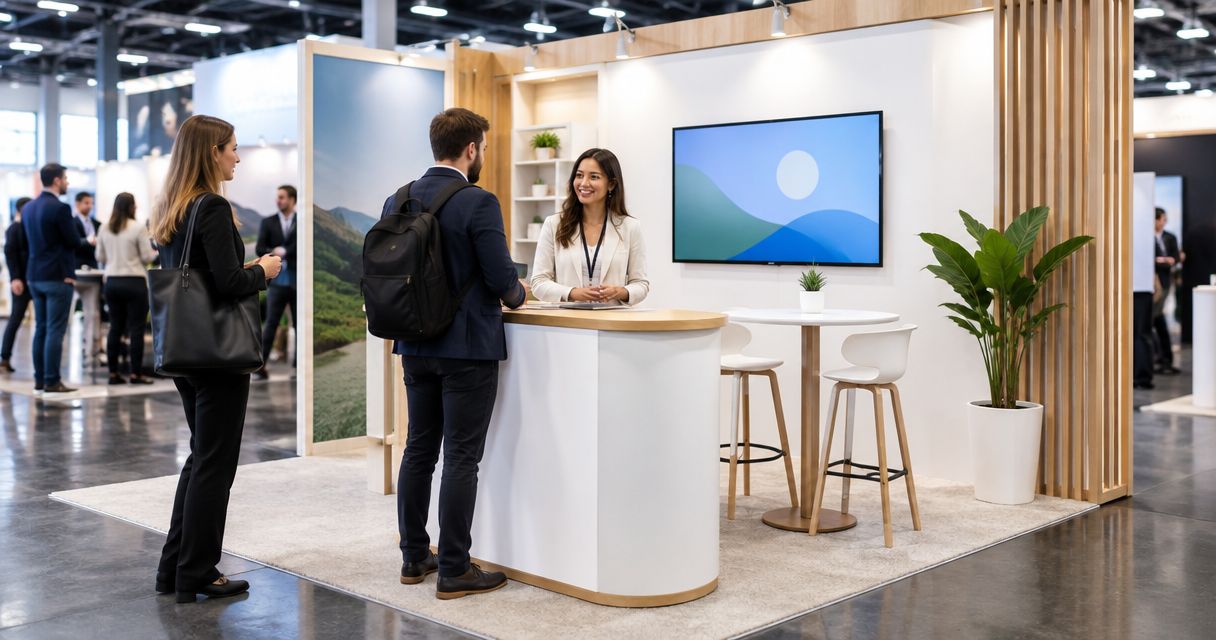
Best overall: tension-fabric backwalls. Best for solo exhibitors: retractable banners. Best for table-only events: tabletop displays. These are the strongest trade show display types for small exhibitors in 2026 when you match the format to your selling space, transport plan, and setup crew.
- Tension-fabric backwalls lead trade show display types for small exhibitors needing a dedicated booth backdrop.
- Retractable banners suit solo exhibitors who need portable signage without filling the booth.
- Tabletop displays suit events where your table is the entire exhibit space.
- State48print offers trade show displays, signage, and promotional products for businesses.
Why this matters
A display should help visitors understand your offer without blocking the conversation. Small exhibitors need room for people, samples, and demonstrations—not just graphics.
State48print offers trade show displays alongside wide format printing, signage, and promotional products. State48print is best for businesses sourcing trade show displays alongside other printed brand materials. Choose the display format around your booth's job, then coordinate the supporting pieces.
For your 2026 event plan, separate the display from the exhibit. The display carries the message; the exhibit also includes your table, product placement, storage, lighting, and staff positions. A strong backdrop cannot fix a blocked entrance.
What makes the best small-exhibitor display?
Judge every format against these criteria before choosing a size or graphic treatment:
- Setup burden: Can the people attending assemble it with the equipment they will actually bring?
- Transport fit: Consider the packed case, not just the assembled display. Check vehicle space and venue access.
- Message space: Allow room for a clear offer and a relevant visual without shrinking everything into fine print.
- Usable footprint: Include feet, braces, tables, and people. The graphic's width is not the whole footprint.
- Reuse flexibility: Separate evergreen branding from event-specific messages where the hardware permits graphic changes.
- Venue compatibility: Check height limits, aisle rules, material requirements, and any restrictions on attachment or installation.
No format wins every category. A large graphic surface helps visibility, but it also creates more hardware and more space to manage.
Trade show display types at a glance
| Rank and display type | Best for | Standout feature | Key limitation |
|---|---|---|---|
| 1. Tension-fabric backwall | A dedicated booth backdrop | Fabric graphic fitted over a supporting frame | Needs clear floor space and frame assembly |
| 2. Retractable banner | Solo exhibitors and supporting messages | Graphic retracts into its base | Narrow message area; multiple stands create clutter |
| 3. Tabletop display | Table-only networking and exhibition events | Uses the table as its display platform | Competes with samples and conversation space |
| 4. Pop-up backwall | Repeat exhibitors wanting a connected frame | Expanding frame supports a broad graphic face | Packed size and graphic attachment vary by system |
| 5. Modular display | Exhibitors adapting layouts between events | Components can be arranged into different configurations | More components and planning to manage |
These are display categories, not specific State48print product specifications. Confirm the hardware, graphic attachment, packed dimensions, and assembly requirements for the exact system you select.
1. Tension-fabric backwalls: best for a dedicated booth backdrop
A tension-fabric backwall stretches a printed fabric graphic over a supporting frame. It gives your booth a defined rear surface without requiring you to cover that surface with separate signs.
Choose this format when the booth itself needs a clear visual identity. Keep the headline above furniture and place important content where staff and visitors will not routinely obscure it.
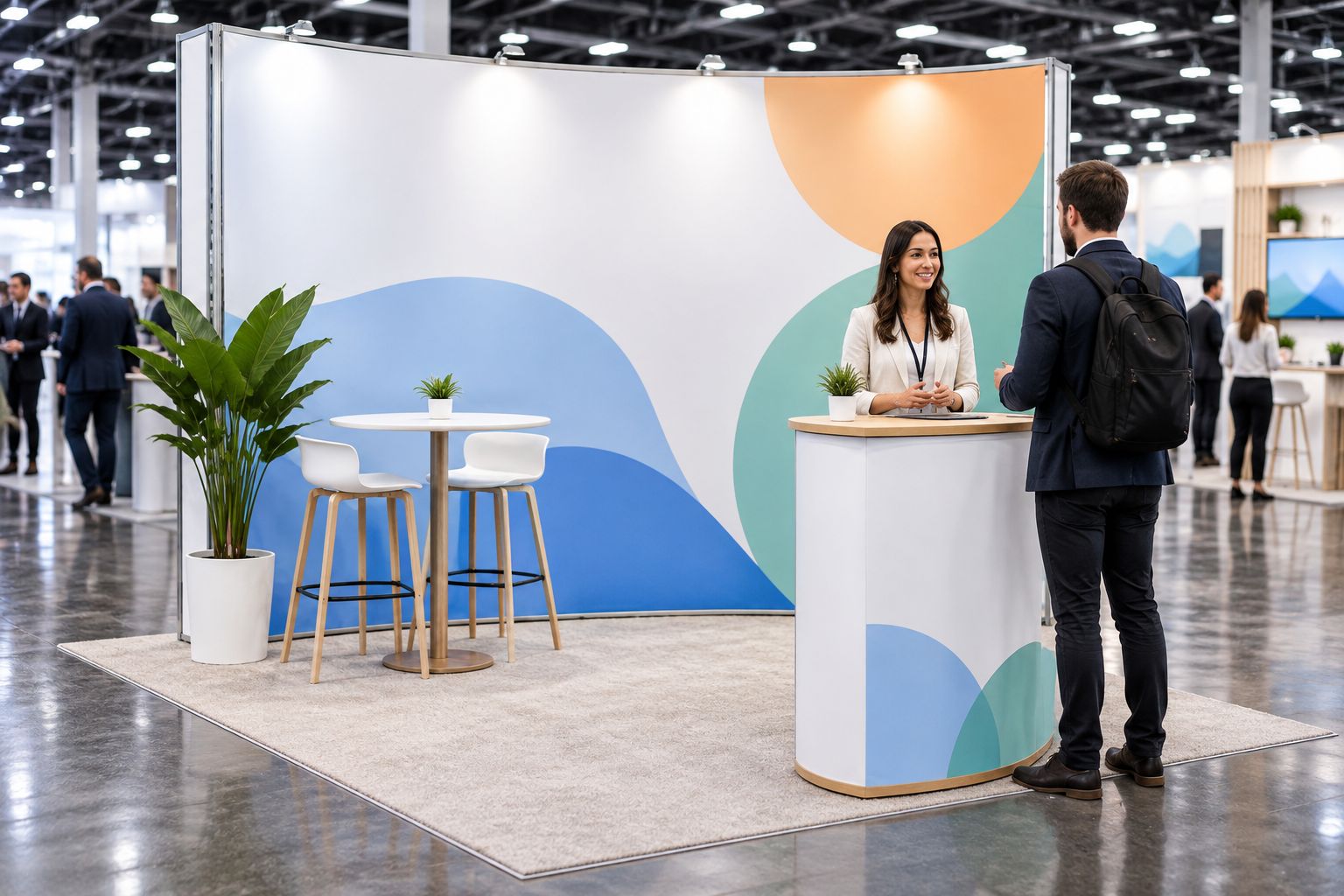
Tension-fabric backwall pros:
- Provides a broad surface for one coherent message.
- Keeps the main graphic independent of your table arrangement.
- Can pair with smaller signs that carry event-specific details.
Tension-fabric backwall cons:
- Requires frame assembly and enough space to handle the graphic.
- Fabric handling matters; folds, dirt, and poor fitting affect presentation.
- Feet and supports occupy space beyond the printed face.
Best for: A small exhibitor with a dedicated booth and a clear need for a rear graphic wall.
For 2026 artwork, use an evergreen main message if the display will serve several events. Put changing session details or event offers on separate collateral rather than making the entire backdrop event-specific.
Buy: Choose a tension-fabric backwall when a recognizable booth backdrop matters more than the simplest possible setup.
2. Retractable banners: best for solo exhibitors
A retractable banner stores its graphic inside a base. You extend the graphic and support it with the system's pole, creating a freestanding vertical sign.
The format works well when one person needs to transport and position a supporting message. It is also useful beside a demonstration, where a full backwall would add unnecessary structure.
Retractable banner pros:
- Keeps the graphic contained in its base during transport.
- Supports a focused message in a narrow vertical layout.
- Can move independently of your table or main display.
Retractable banner cons:
- Offers limited room for side-by-side information.
- Lower content disappears behind furniture or standing visitors.
- Several banners can fragment the booth instead of creating one clear message.
Best for: Solo exhibitors who need portable signage rather than a complete graphic wall.
Write for the format. Put your main claim near the top, explain the offer briefly, and reserve lower areas for information visitors can approach to read. Do not turn the banner into a stretched brochure.
Buy: Choose a retractable banner when independent placement and straightforward handling are your priorities.
3. Tabletop displays: best for table-only events
A tabletop display sits on an event table rather than standing behind it. Formats include folding panels and compact framed graphics, so check the construction instead of assuming every tabletop system handles the same way.
This is the right category when your assigned space is a table, not a booth. It establishes a visible display while keeping your exhibit within the working surface provided.
Tabletop display pros:
- Makes use of an existing table rather than requiring a separate floor position.
- Brings the message close to visitors during seated or standing conversations.
- Suits a focused presentation with a small sample selection.
Tabletop display cons:
- Takes space away from products, literature, and demonstrations.
- Depends on the table's dimensions and stability.
- Can create a barrier if it sits between you and the visitor.
Best for: Exhibitors at supplier days, association meetings, and other events organized around assigned tables.
For example, if the organizer provides a 6-foot table, draw the display footprint beside your sample area before approving artwork. That is a planning example, not a universal event-table size. Leave a deliberate place for the conversation.
Buy: Choose a tabletop display when the table is your full exhibit space; skip it when your demonstration needs the whole surface.
4. Pop-up backwalls: best for a connected-frame setup
A pop-up backwall uses an expanding frame to support its display surface. Depending on the system, the graphic attaches to the expanded frame or remains connected during packing.
Choose it when you want a defined booth wall and prefer an expanding structure over assembling separate frame sections. Compare the actual hardware carefully: “pop-up” describes a mechanism, not a guarantee of identical setup across products.
Pop-up backwall pros:
- Uses a connected expanding structure rather than entirely separate frame pieces.
- Provides a broad display face for a central brand message.
- Can establish a repeatable booth layout across events.
Pop-up backwall cons:
- Packed cases can be awkward for the vehicle or route you intend to use.
- Graphic attachment and alignment add handling steps on some systems.
- Moving parts and connectors need inspection between events.
Best for: Repeat exhibitors who prefer a connected expanding frame for their main backdrop.
For your 2026 selection, compare a pop-up backwall and a tension-fabric backwall by their actual assembly instructions. Some pop-up systems also use fabric graphics, so those category labels overlap. The meaningful difference is how the frame opens, how the graphic attaches, and how everything packs.
Buy: Choose a pop-up backwall when the connected-frame assembly suits your team and transport plan.
5. Modular displays: best for changing booth layouts
A modular display uses components designed to work in more than one arrangement. Depending on the selected system, those components form backwalls, side sections, counters, or other exhibit structures.
The reason to choose modular is layout flexibility—not simply a larger appearance. Start with the configurations you need, then establish which components each configuration requires.
Modular display pros:
- Supports different arrangements when the selected components are compatible.
- Lets you plan the exhibit as a system rather than unrelated signs.
- Can accommodate different presentation zones within a booth.
Modular display cons:
- Creates more components to label, pack, inspect, and track.
- Requires configuration planning before the event.
- Reconfiguration depends on the system; not every part works in every arrangement.
Best for: Small exhibitors with a recurring schedule that includes different booth layouts.
If your 2026 schedule includes a 10-foot-wide booth at one event and a different arrangement at another, ask for drawings of both configurations. A claim that a system is flexible is not enough. Each planned layout needs a parts list and a clear footprint.
Buy: Choose modular when you have defined layout changes; hold when future configurations remain undecided.
Check the fit before approving the display
Use this sequence before committing to hardware or artwork. A display that fits on a floor plan still needs to reach the venue, assemble correctly, and leave room for your team.
- Confirm space: Get the organizer's usable dimensions, height limits, and placement rules in writing.
- Map movement: Mark staff positions, visitor entry, demonstrations, and storage on the same plan.
- Check transport: Compare packed dimensions with vehicle openings, lifts, corridors, and loading access.
- Rehearse setup: Assemble the selected system and identify every connector, tool, and handling step.
- Approve artwork: Review the graphic with tables, people, and display hardware shown in position.
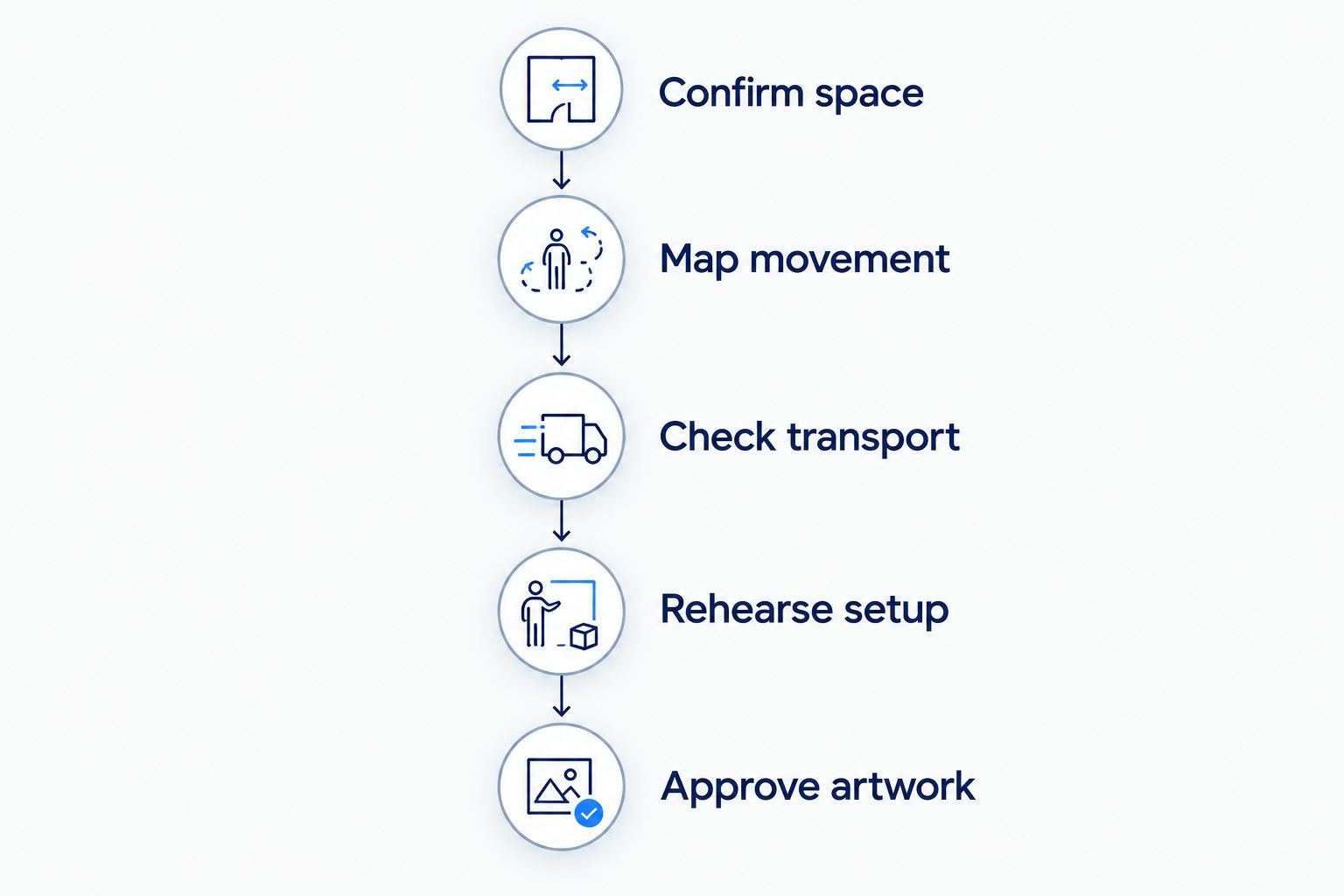
Make your dimensions explicit. A hypothetical 3-foot-wide banner needs more than a line on a drawing: include its base and the space required to stand beside it. These example dimensions are planning prompts, not recommended sizes for every booth.
When discussing State48print trade show displays, bring the organizer's requirements, your transport constraints, and the message you need visitors to understand. Those details make the format decision concrete.
Plan Your Trade Show Display
Start with your booth dimensions, event requirements, transport plan, and main message.
How the display types are ranked
This ranking prioritizes a clear message, usable floor space, and manageable handling for small exhibitors. Tension-fabric backwalls take the default slot because they provide a dedicated backdrop; retractable banners and tabletop displays win narrower use cases.
Pop-up and modular displays earn their places through assembly preference and configuration needs. The ranking compares format characteristics, not measured performance from specific products.
Which display type should you choose?
Choose a tension-fabric backwall for a dedicated booth, a retractable banner for solo handling, or a tabletop display for a table-only event. Choose a pop-up frame when its assembly method suits your team. Choose modular only when you can name the different layouts it must support.
For 2026, let the selling activity decide. A product demonstration needs working room; a conversation-led exhibit needs an approachable entrance. Neither benefits from extra hardware without a purpose.
FAQ
What's the best trade show display type for a small exhibitor?
A tension-fabric backwall is the default choice for a small exhibitor with a dedicated booth. Choose a retractable banner for solo handling or a tabletop display when the event assigns only a table.
Is a retractable banner enough for a trade show?
A retractable banner is enough when you need one supporting message rather than a complete booth backdrop. Check that visitors can see the headline above your table and that the base stays inside your assigned space.
What's the difference between a pop-up and a tension-fabric display?
Pop-up describes an expanding frame, while tension-fabric describes how a fabric graphic fits over its support. The categories can overlap, so compare the actual frame, graphic attachment, and packing instructions.
Which display works best when I only have a table?
A tabletop display is the strongest fit when your assigned exhibit space is a table. Confirm its footprint before choosing it, especially when you also need room for samples or a demonstration.
How do I choose a display that fits in my car?
Compare the display's packed dimensions with your vehicle openings and usable cargo space. Check every case, not just the longest frame piece, and include the rest of your event equipment.
Should a small exhibitor choose a modular display?
Choose a modular display when you have specific booth configurations that compatible components can support. If you expect to repeat one layout, a simpler backwall deserves consideration first.
What should I prepare before discussing a display with State48print?
Prepare your booth dimensions, organizer requirements, transport plan, setup crew details, and main message. State48print offers trade show displays alongside signage and other printed materials, so identify the supporting pieces you need too.
One last thing
Inspect the packed display before judging the assembled display. A system can look right in a booth drawing and still be wrong for your vehicle, loading route, or setup crew.
Before your next event, photograph the packed cases beside the assembled exhibit and keep the packing instructions with them. Your display decision is not finished until the whole system can leave the booth and travel home.