Best overall: aluminum composite panels. Best for flexible banners: solid vinyl. Best for temporary yard signs: corrugated polypropylene. This 2026 guide compares large format printing materials for outdoor signage by installation, exposure, appearance, and reuse—not unsupported lifespan promises.
- Aluminum composite panels lead large format printing materials for outdoor signage when you need a flat, rigid sign.
- Choose solid vinyl for flexible banners and mesh vinyl for fence applications that need airflow.
- Choose corrugated polypropylene for temporary yard signs; cast adhesive vinyl needs a compatible supporting surface.
- State48print provides wide format printing for businesses coordinating signage with other branded materials.
Why this matters
Outdoor signs fail as systems, not just as sheets of material. A suitable substrate still needs compatible ink, finishing, hardware, and a mounting plan that fits the site. A stronger panel does not fix weak attachments.
State48print is a fit for businesses combining outdoor signage with broader print campaigns. Its services include wide format printing, branded environments, commercial printing, vehicle wraps, and trade show displays. Start with State48print when those pieces belong in the same business brief.
The right question for your 2026 project is not simply which material lasts longest. Ask which material suits the location, message, installation method, and replacement plan.
What makes the best outdoor signage material?
Judge each option against these criteria before choosing a substrate:
- Exposure: Account for sunlight, rain, wind, and contact with irrigation or cleaning equipment. Evaluate the complete printed construction, not the substrate alone.
- Mounting: Decide whether the sign attaches to a wall, fence, frame, posts, or an existing smooth surface. Each creates different attachment demands.
- Rigidity: Choose a rigid panel when the graphic must hold its shape. Choose a flexible sheet when the installation supports and tensions it.
- Readability: Match the surface finish, contrast, and graphic layout to the viewing position. Glare and obstructions can undermine otherwise readable artwork.
- Replacement: Separate campaign graphics from continuing identification. A sign you expect to change should be straightforward to remove and replace.
- Compatibility: Confirm that the substrate, ink, adhesive, coating, and supporting surface work together. A material name alone is not a complete specification.
Outdoor signage materials at a glance
The order below ranks practical use cases, not universal material quality. These 2026 recommendations distinguish the sign face from the structure holding it.
| Material | Best for | Standout feature | Key limitation |
|---|---|---|---|
| Aluminum composite panels | Fixed rigid identification signs | Flat, rigid panel construction | Requires an appropriate mounting system |
| Solid vinyl banner | Flexible event and promotional banners | Rolls for transport and storage | Needs supported, reinforced attachment points |
| Corrugated polypropylene | Temporary yard and directional signs | Lightweight, fluted plastic construction | Less rigid than structural panel options |
| Cast adhesive vinyl | Graphics on compatible existing surfaces | Conforms to suitable curves and contours | Cannot function as a freestanding sign |
| Mesh vinyl | Fence banners requiring airflow | Perforations let some air pass through | Open area reduces image coverage |
| Acrylic | Dimensional lettering and illuminated sign faces | Can transmit light in suitable grades | Can crack under unsuitable drilling or loading |
1. Aluminum composite panels: best for fixed rigid signs
Aluminum composite material, commonly called ACM, combines aluminum face sheets with a core. It provides a flat surface for printed graphics or applied lettering and suits identification signs that need a rigid face.
Best for: fixed business identification and rigid wall-mounted graphics. ACM is the default recommendation when you need a panel rather than fabric or adhesive film. The mounting structure still determines how the sign handles its installation environment.
Aluminum composite panel pros:
- Holds a flat graphic face without banner-style tensioning.
- Supports direct printing or applied graphics when the selected system is compatible.
- Suits rectangular panels and fabricated shapes.
Aluminum composite panel cons:
- Needs suitable support, fasteners, and edge treatment.
- Dents and damaged edges can remain visible.
- Core composition and panel construction need checking against applicable project requirements.
Specify the actual panel construction rather than accepting ACM as a complete description. For building-mounted work, confirm applicable code requirements before fabrication. Do not treat a sign panel as a structural component or assume every composite core has the same fire classification.
Verdict: Buy aluminum composite panels for fixed rigid signage; skip them when the sign needs to roll up.
2. Solid vinyl banner: best for flexible promotional signs
Solid vinyl banner material provides a flexible printed face for promotions, events, and temporary announcements. It works as part of a supported installation, with finishing selected around the attachment method.
Best for: promotional banners that need flexible handling and storage. Solid vinyl offers uninterrupted print coverage, unlike mesh. That makes it useful when photographs, small details, or dense graphics matter to the design.
Solid vinyl banner pros:
- Rolls for transport and storage.
- Provides continuous image coverage.
- Accepts finishing such as hems, pole pockets, or grommets when appropriate to the construction.
Solid vinyl banner cons:
- Can crease when folded or handled poorly.
- Transfers wind force to attachment points and supporting structures.
- Does not hold a flat shape without adequate support or tension.
For a 2026 event banner, settle the mounting method before approving the artwork. Pole pockets and reinforced edges change the usable layout. Keep essential text away from areas occupied by seams, pockets, and hardware.
Do not select banner material by weight alone. Construction, tear resistance, finishing, and installation all matter. Ask for a specification matched to the site rather than assuming a heavier sheet solves every problem.
Verdict: Buy solid vinyl for supported promotional banners; skip it as a substitute for a rigid sign face.
3. Corrugated polypropylene: best for temporary yard signs
Corrugated polypropylene is a lightweight plastic sheet with internal flutes. It is commonly used for temporary yard signs, directional messages, and campaign graphics where portability and replacement matter more than a substantial architectural appearance.
Best for: temporary ground-level signs and changing directional messages. Its fluted structure makes orientation important, particularly when a compatible stake system inserts into the sheet.
Corrugated polypropylene pros:
- Easy to handle and move between locations.
- Suits simple, high-contrast messages.
- Works with compatible stakes or framed mounting systems.
Corrugated polypropylene cons:
- Can flex or bow without adequate support.
- Flutes and edges give it a visibly temporary appearance.
- Stake compatibility depends on sheet construction and orientation.
Keep the message brief. A directional arrow, destination, and clear action usually serve the format better than a brochure-sized block of text. Confirm placement permissions before treating a verge, sidewalk edge, or roadside location as usable space.
Corrugated polypropylene is not a replacement for an engineered permanent sign. Select it because the job is temporary, not because a lightweight sheet can take on every outdoor application.
Verdict: Buy corrugated polypropylene for temporary yard signs; skip it for permanent architectural identification.
4. Cast adhesive vinyl: best for compatible existing surfaces
Cast adhesive vinyl is a graphic film applied to a supporting surface. Suitable products conform to curves and contours, making the category relevant to vehicle graphics and other applications where a rigid panel cannot follow the shape.
Best for: graphics applied to compatible existing surfaces. The key distinction is simple: adhesive vinyl changes a surface; it does not supply the structure underneath.
Cast adhesive vinyl pros:
- Adds graphics without a separate freestanding panel.
- Conforms to suitable shapes when specified and installed correctly.
- Supports coordinated graphics across compatible surfaces.
Cast adhesive vinyl cons:
- Adhesion depends on surface condition and compatibility.
- Installation errors can produce bubbles, lifting, or visible seams.
- Removal results depend on the film, surface, exposure, and condition.
Check the substrate before approving production. Failing paint, contamination, rough texture, and incompatible coatings require attention first. Where a laminate is specified, confirm compatibility with the printed film and intended application.
An attractive rendering cannot prove that a surface will accept adhesive graphics. Require a suitability check and follow the selected material manufacturer's installation instructions.
Verdict: Buy cast adhesive vinyl for suitable existing surfaces; skip it when you need a self-supporting sign.
5. Mesh vinyl: best for fence banners requiring airflow
Mesh vinyl has an open structure that lets some air pass through the graphic. It is a practical option for fence-mounted messages where a solid sheet would present a more continuous surface to the wind.
Best for: fence graphics where airflow is part of the installation plan. Mesh changes airflow through the sign face. It does not establish that the fence, posts, or attachments can safely carry the installation.
Mesh vinyl pros:
- Allows some airflow through the printed face.
- Suits large graphics viewed from a distance.
- Offers a flexible alternative to rigid fence panels.
Mesh vinyl cons:
- Open areas reduce printed image coverage.
- Background objects can show through and weaken contrast.
- Small text and fine details are less forgiving.
Use bold shapes and a restrained message. Check the graphic against the actual background, not just a white proofing page. A design that reads clearly on screen can lose definition against trees, vehicles, or a busy construction site.
Verdict: Buy mesh vinyl for suitably supported fence graphics; skip it when uninterrupted image coverage is the priority.
6. Acrylic: best for dimensional and illuminated signage
Acrylic is a rigid plastic used in dimensional letters and sign faces. Transparent, translucent, and opaque grades serve different purposes; the correct choice depends on whether light should pass through the material.
Best for: dimensional lettering and compatible illuminated sign assemblies. Acrylic belongs in a fabricated sign plan, not simply a material swap for every outdoor panel.
Acrylic pros:
- Supports dimensional lettering and shaped sign components.
- Offers light-transmitting options for suitable illuminated assemblies.
- Provides a smooth face for compatible graphic treatments.
Acrylic cons:
- Can crack around poorly designed holes or stressed attachment points.
- Needs allowance for thermal movement.
- Requires careful handling to avoid surface damage.
For illuminated work, evaluate the face material with the lighting and cabinet design. A daytime color proof does not show the full nighttime result. Confirm the complete assembly rather than choosing acrylic on appearance alone.
Verdict: Buy acrylic for specified dimensional or illuminated signage; skip it as an automatic replacement for ACM.
How these materials rank
The ranking prioritizes fit: rigidity for fixed signs, flexibility for banners, portability for temporary signs, surface compatibility for adhesive graphics, airflow for mesh, and light transmission for acrylic. It is not a controlled performance test or a promise of service life.
For State48print wide format printing projects, specify the application before requesting the material. That keeps the discussion focused on the finished sign rather than an isolated sheet specification.
Check the installation before approving production
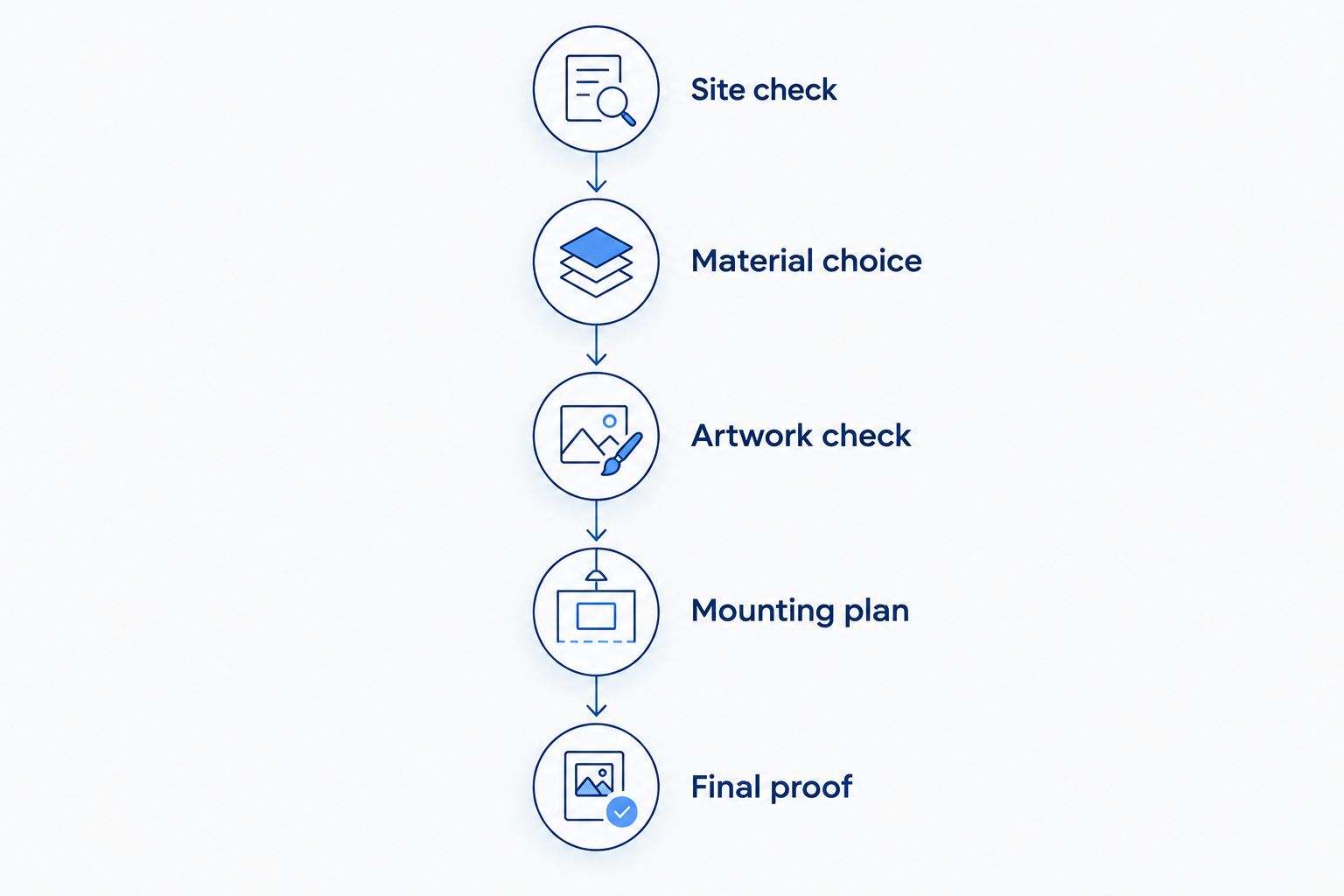
Use this sequence for your 2026 sign brief. Resolve physical constraints before the print file becomes the main discussion.
- Site check: Record the supporting surface, exposure, access, and permission requirements.
- Material choice: Match the substrate to the sign's job and replacement plan.
- Artwork check: Review contrast, message length, and finishing clearances.
- Mounting plan: Confirm support, attachments, and responsibility for installation.
- Final proof: Approve the artwork and physical construction together.
Make the proof useful. Review it from 2 viewing positions: the intended approach and the closest normal reading point. Request 1 full-size sample of the smallest important text if readability remains uncertain. Record 3 mounting details in the brief: supporting surface, attachment method, and installer responsibility. These are recommended checks, not performance ratings.
Plan Your Outdoor Signage
Match your sign's location, material, artwork, and mounting requirements before production.
Which outdoor signage material should you choose?
Choose aluminum composite panels as the default for fixed rigid signs. Choose solid vinyl when the installation needs a flexible banner, corrugated polypropylene for temporary yard signs, cast adhesive vinyl for compatible surfaces, mesh for airflow, and acrylic for specified dimensional or illuminated work.
State48print handles outdoor signage within a broader wide format printing offering. Bring the location, intended message, mounting conditions, and replacement plan to the brief; those details make the material decision actionable.
FAQ
What's the best material for outdoor business signs?
Aluminum composite panels are the default recommendation for fixed rigid business signs. The complete specification must also address mounting, printed graphics, exposure, and applicable requirements.
Is mesh better than solid vinyl for a fence banner?
Mesh is the better fit when airflow through the banner is a requirement. Solid vinyl provides uninterrupted image coverage, while mesh needs artwork that remains readable despite its open structure.
Can I use adhesive vinyl as a freestanding outdoor sign?
No. Adhesive vinyl needs a compatible supporting surface. Use a suitable rigid panel or supported banner construction when the installation must supply its own sign face.
Is corrugated polypropylene suitable for permanent signage?
Corrugated polypropylene is better suited to temporary yard and directional signs than permanent architectural identification. Its lightweight, fluted construction needs support and does not replace a permanent sign system.
How long will an outdoor printed sign last?
Service life depends on the specific substrate, print system, finishing, exposure, installation, and maintenance. Request guidance for the complete specified construction rather than accepting a lifespan based only on the material category.
Should I choose acrylic or aluminum composite for outdoor signage?
Choose acrylic for specified dimensional lettering or illuminated sign faces; choose aluminum composite for a flat, rigid panel. Neither choice removes the need to check mounting, thermal movement, and the finished assembly.
What should I include in a 2026 outdoor signage brief?
Include the location, supporting surface, viewing position, message, exposure, mounting requirements, and replacement plan. Add site photographs and identify who is responsible for permissions and installation.
One last thing
Photograph the empty sign location before designing the graphic. Include the approach, background, and attachment area. That simple brief exposes obstacles a clean artwork proof hides—and helps you choose a sign people can actually read.